Monday, 10 January 2011

Spiders' Webs, Hoar Frost and a Festive Walk

Spiders’ webs are great structures for children to look at, copy the patterns and to view spiders.  Back in September the spiders were hard at work in the garden weaving away.  It was impossible for me to pass through my archway without getting threads tangled in my hair.  However by the time I got my act together to photograph some of the webs the spiders seemed to have all miraculously disappeared. 


So at Christmas I was delighted to find some webs sparkling with hoar frost.  The frost shows off the patterns perfectly.  Apparently an orb web is the one we most commonly see and link with spiders in the UK.  The spider anchors silk lines that radiate from a centre, to grass, stems and other structures. It then weaves a sticky spiral of silk around the centre.  Threads are then woven round to strengthen the outside of the web.  It is the stickiness of those threads that attracts water from the air so making water droplets.  There is more information on spiders and some activities for kids by The British Council.

That same day the hoar frost was so amazing that the camera was a must for a walk around the garden and then further afield.  This was certainly a snowy glittery Christmas for us.


Sunday, 21 November 2010

What to do with all those Leaves in the Garden


Making Leaf Mould


We have been making leaf mould in our garden and have done so for the last couple of years. It is an easy gardening activity for children; one that gets them into the garden in the autumn. Leaf mould is organic and involves no carbon footprint. It is simply a case of raking up the leaves, bagging them and storing them, and then waiting.


Here’s how we do it. The garden has leaves mainly from Silver Birch, Goat Willow, Oak and a little bit of Acer. We rake them into piles and bag them up. I know that many people use black plastic sacks. We recycle and use the plastic coverings you get when clothes are returned from the dry cleaners. We like it best if the leaves are dry as they are not so cold to handle. As water is an essential ingredient for leaf mould we place couple of holes in the plastic bag and the add water.


A couple of times I have left some bags of leaves under shrubs and find that as the plastic begins to disintegrate and worms worm their way into the leafy mixture the leaves return themselves to the garden with very little help.


The filled sacks then spend the following 18 months in an old dustbin in the garden. We spread the leaf mould out onto the soil early spring as a kind of mulch. This is another gardening job for the children help with. I have also sieved the leaf mould and used it with potting compost for transplanting seedlings.


Last years leaf mould
 The people at Gardening Organic have more detailed advice about what to do.

But why oh why is it called leaf mould? There is nothing messy or mouldy about it. It doesn’t smell and once rotted down turns into a lovely friable material. The name conveys up images of fungus and stained walls and must surely put some people off. How about calling it leaf compost or leafy soil?  Love to hear your suggestions.

Let me know what you do with the leaves in your garden. Please please don’t say you take your leaves to the local rubbish tip. We find it so simple to recycle them inside our garden and hope you can too.


Wednesday, 3 November 2010

The London Wetland Centre: A Great Garden in the Heart of London.


If you hadn’t thought of a wetland as a garden, then please think again. All the elements of natural beauty, native planting, seasonal interest, open space, and water are present in a wetland. For me and for my son the London Wetland Centre is a fantastic garden. We had one of our many visits there this week and I thought I would share with you some of the simple pleasures he loves there.

  • The trail of the duck feet marked on the ground leading to explore the children’s adventure play area.
  • The mock duck nest and its eggs, together with the ‘dinosaur’ bones.
  • The new webcam set up in a pond, filming both on top and under the water. He spent ages operating this, focusing, zooming in and out, and looking at the screen to see what he had found.
  • The pathways that lead off the main pathways and then rejoin later on.
  • The willow dens, both when they are covered in leaves and in their winter state.
  • The foot operated water pump in the new rain garden.
And for me there is always something new. This time it was the new rain garden. Opened by Alan Titchmarsh in September it shows how gardens can be sustainable by capturing and using rainfall. It forms a series of rain gardens, fed from the roof of a pavilion.  This is made from a converted cargo container and  provides living space for animals and insects in its walls and a green roof. There is a prism to view the  green roof.


I do not have a full photo of the garden to show you as was so bowled over by the fact that a flower meadow was still flowering in November that I concentrated on the flowers.  I have since learnt that they are from Pictorial Meadows. They provide an unique colourful meadow-flower seed mixes that rapidly produce a naturally vibrant display with an extended flowering season. The mixes contain no grass and all the green foliage you see are part of the plants.


So Wetlands are not all about birds, though there is presently a bittern at the London Wetland Centre and plenty of other wildfowl to see and things to do.  And, oh yes, there are also at least the six water voles we saw at the Wetland Centre in Arundel this summer.


Wednesday, 20 October 2010

Gardens to Visit with Your Children in October

The Eden Project Cornwall

Thousands of families will currently be thinking about where to go in the autumn half term holiday with their kids. If you live in London, the South East or Scotland there are some great ideas on garden destinations on kidsinthegarden . The winter garden at Hillier’s garden in Hampshire will be looking particularly good. The Kids Guide has some suggestions for gardens to visit in the North West of the UK.

Most of the RHS and National Trust gardens will have some sort of family event and/or trail available at this time of year. There will also still be plenty to see if you have a botanical garden located close to you.

A good choice this time of year is a visit an arboretum or a garden with woodland. Nothing beats a good play in the leaves. Here the opportunity to pick up leaves, conkers and fir cones should keep everyone amused. We always come away with our pockets full of precious collections. The Woodland Trust has an ‘autumn colour’ search category for its index of 1,000 plus woodland sites across the country.

The Royal Parks in London are all free to visit and all have gardens and/or woodland gardens. As a family we will be visiting Kensington Gardens next week, both the Peter Pan-themed Diana Memorial playground and the outdoor exhibition by Anish Kapoor of large reflective metal structures.  I am intrigued to see what my son will make of them.

I love visiting a Wetlands Centre this time of year.  Not only is it a good time to see the winter birds just arrived in the UK you also get the evocative sound of rustling wind in the reed beds. So they are great places to play sound games with the children.

If you have a favourite garden to visit this time of year please leave a comment and share it with us all.

Thursday, 30 September 2010

Gardening Helps to Grow your Children.


Get gardening with your children and give them skills they will use for the rest of their lives. All of us committed to children’s gardening know that it helps to promote a healthy and active life style. New research by the Royal Horticultural Society shows that it can also improve confidence, resilience and self-esteem. The report concentrated on Gardening in Schools.  However much of its findings can also translate into gardening at home with your kids.


Here are a few detailed findings of the report pertinent to gardening in most settings.

  1. Tasks such as planting seedlings and tying plants to canes can help to develop children’s fine motor skills.
  2. The changeable nature of gardening projects and uncertainty e.g. weather and plant disease forced children to become more flexible and think on their feet.
  3. Waiting for crops to grow taught the value of patience.
  4. Public praise for a school garden generated a sense of pride.
  5. A calm outdoor space helped to improve children’s concentration.
  6. Gardening helped children to take responsibility for their own physical health and diet. Children who grew their own crops displayed a greater willingness to eat new vegetables.
What better reasons are there for you and your children to get gardening.  Don’t leave it all to the school.


Thursday, 16 September 2010

How Did Your Vegetables Grow


September 2010

April 2010


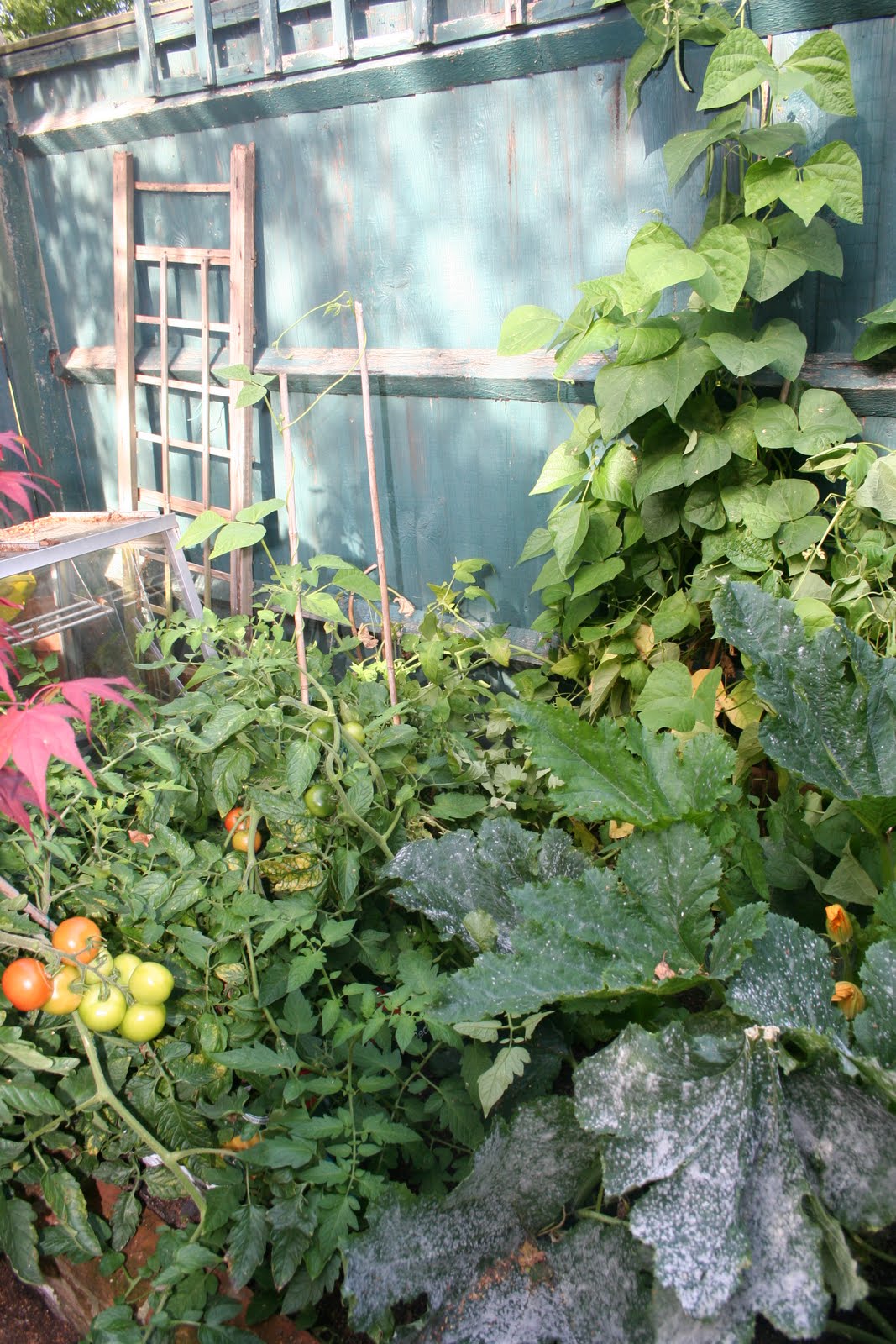
I posted back in February about the new vegetable plot in the garden and you’ll see from the photo that it is now full of vegetables and vegetation. We have had great success in growing tomatoes, courgettes, strawberries and beans and are currently harvesting daily. The tomatoes have been prolific. We have not been so lucky with the carrots, onions and garlic.


Lessons learnt include
  1. Use a type of courgette which has smaller leaves and therefore uses up less space on a small plot.
  2. Provide stronger staking for the tomatoes.
  3. Plant more beans because they are so yummy and help us avoid using the beans flown in from Kenya. 
  4. Plant strawberries in pots and hanging baskets next year to prevent slug damage.


My son has got his hands dirty in every sense. He has loved watering, picking and eating the veg. If we were away for a couple of days in the summer holidays his (and my) first action was to run down the bottom of the garden to check out the activity in the vegetable plot

I am going to sow some Kale – ‘Nero di Toscana’ and some winter salad in the next couple of days and then start doing a good search of the seed catalogues. Can’t wait for next year.


Thursday, 19 August 2010

Dens and Mazes

Top of the list of children’s favourite things to do in a garden has got to be building dens and running around a maze. We visited Wisley in Surrey this week and found both of these.


The children’s play area has been upgraded to include a fantastic den building area. A great way to keep your children occupied in a really constructive way. The frames of the dens are provided by permanent wooden poles stacked into the ground. A range of building material is then provided for your kids to create what ever they want. It was interesting to see the different techniques eomployed.  There were those children who kept redoing their den, those who just wanted to chill out inside, some made elaborate doors and some dens were completely sealed up. There are some ideas for creating a den in your garden at Kidsinthegarden.  If you have a large garden the Wisley format is a great idea.


As well as the usual climbing frames and stepping stones there was also novel spying area.  The blue circles in the wooden stakes pictured above are binoculars.


A sunflower maze is a great idea. Unfortunately due to lack of water the giant sunflowers at Wisley were only about 3 feet high, but the little ones still couldn’t see over.  It also meant that the sunflower heads were accessible so the whole maze was filled with sunflower faces and patterns created by the children. My favourite mazes in the South East of the UK are the hedge maze at Hampton Court Palace and the water maze at Hever Castle in Kent. We are just back from Normandy where maize mazes are very popular. The one we tried took well over an hour to find our way around, testing the patience of our 5 year old, so a little bit of cheating went on.  If you would like to visit one in the UK Adrian Fisher, the master maze creator, lists a number of maize mazes in this country.
Related Posts with Thumbnails