Showing posts with label children's garden. Show all posts

Friday, 22 February 2013

Community Garden at Dean City Farm

Please note that this blog has now moved to Kidsinthegarden. We would love you to take a look.


This week we had an invite to visit Dean City Farm just South of Wimbledon.  I was slightly uncertain whether it would hold enough interest for my 8 yr old. However my friend knows me well. ‘ They also have a community garden’ she says dangling a large carrot before me and knowing that I am never one to miss the chance to visit a garden.
The Farm is situated on land owned by the National Trust’s Morden Hall Park, but you enter the farm through a light industrial site.  It certainly is in an urban setting.  However this is just one side of the farm.  The other boundaries are the River Wandle (this is the river that gives Wandsworth its name) and the tram line which runs between Wimbledon and Croydon.  This tramline is a real added bonus for children as the trams are frequent,  a bit of a novelty in this part of London and great for spotting.


Morden Hall Park


Morden Hall Park
Our day started with a quick foray into Morden Hall Park.  What a delight  - a wander along the river Wandle, a foot crossing over the tramline and you then find yourself in a wetland environment  with bull rushes and reeds.  The Park also has a woodland play area and I’m assured by one of my companions that the rose garden has the most perfect stream for a hot summer's day paddle.  The children loved the woodland play area and all the bridges in the Park .  It was poo sticks galore.  There was even one little chappy with a huge supply of sticks on a bridge merrily handing them out to any passing child.   The wetland area the paths were flat and easy for every  child to run around and trace arrows and names in the sandy soil.

Dean City Farm

The Farm has beautiful chickens, the woolliest sheep you have ever seen and an eclectic selection of other animals.  My son’s favourites were the ferrets!  It has a riding school within it and children can also become a farmer for a day or a week - real country kids.  We learnt from one of them that why one of the goats had had its horns cut to stop it curling around and cutting into its skin.  I also learnt a use for those grapes that seem to discolour so quickly.  They are a favourite with ducks, as are tomatoes and lettuce.  White bread apparently does them no good what so ever.


Community garden Dean City Farm
 
 
Willow Spyglass
 

Community Garden


I have saved the best to last as we visited the community garden at the end of our visit.  The farm was very busy on this very sunny February half term day.  For some reason though most visitors passed by the garden and there was an immediate feeling of tranquillity upon entering.  The children loved it.  It seemed to have all the elements to make it really child friendly.  Pathways to run around, raised beds to make access to beds easy, a tree to climb, a pond and places to sit and hide.  For the wildlife there were log piles and bee hotels.
 
bug hotel
 
Lots of the plants were labelled and many were beginning to peep through the ground.  It was clear that many herbs and bee friendly plants were being grown.  I loved the willow spyglass.  The ‘prayer’ flags also seemed to work perfectly in the urban setting. There was a large vegetable bed and all raised beds for veg growing.  It all served to show what can be achieved in a relatively small space of ground


Turf Maze


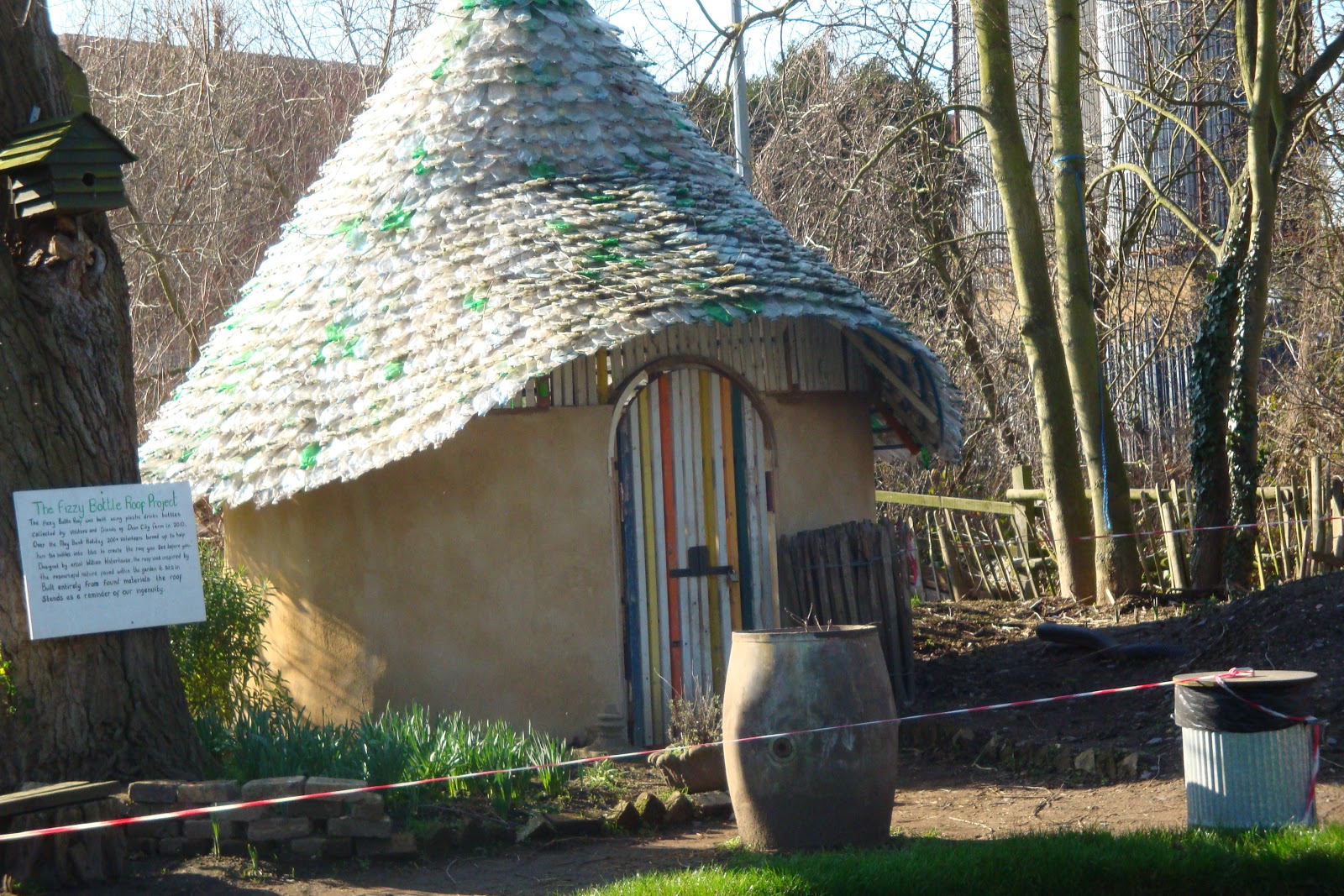
Fizzy bottle roof building


Two features, the turf maze and the fizzy bottle roof building were just a delight.  I have seen greenhouses made of drinks bottles, but never a squashed bottle roof.  Reading more about how it had been built on the garden’s website made me feel quite jealous that I hadn’t been involved.  It obviously had been a real community event.
This garden had clearly been designed and evolved with a great deal of care and attention. The Farm is a touch of the countryside within the city and within that there is this little oasis of a garden, well worth a visit even if you do not have children with you.


Sunday, 2 December 2012

Enchanted Woodland: A Garden At Night


Enchanted Woodland


What a treat.  A night time walk in an enchanted garden, full of light, shadow, glimpses of majestic trees and other delights.  I couldn’t think of anything that could be more charming.

After dressing for the Arctic, we were stuck in London Friday night traffic for 50 minutes on our way there and my 7 year old decided that it really was a waste of time. He much rather be watching his favourite TV programmes.  Great start to our night trip to Syon Park in Isleworth to visit their ‘Enchanted Woodland’.  But please don’t worry, from the time he saw the search lights from the garden in the sky and even the  lights from the under belly of the planes en route to Heathrow, to meeting his friends, his excitement could hardly be contained.

There is no doubt that there is something very magical about a garden, particularly a large garden, at night.  This time of year we all tend to hibernate come dusk.  Night time trips are quite rare for my son.  Although I am all for wrapping up and getting outside there aren’t many winter evenings when we actually manage it.

I have visited the garden at Syon Park quite a few times, but never in the dark.  The Enchanted Woodland had come highly recommended and it did live up to all expectations.


winter wonderland


The garden was full of coloured lights of all shapes, sizes and types.  The reflections from the lit up trees in the water of the lake were simply quite stunning.  The route around the garden was about a mile.  It took us over an hour and a half, such was the level of interest from everyone.


kids looking in dragons den
 
There were constant delights for the children.  One of their favourites was the Dragons Den with its very own sound effects.
 
shadow acreen


A large shadow screen held all our attention for quite some time.  What a good idea. I have never done this outdoors before.  We could also view other families shadows from the other side of the lake, very spooky and surreal.


happy children in a nightimegarden


The tree and their structures were not the only ones lit up.  The children enjoyed being seen in different colours as well.

lit up tree

This children named this little display jurassic cove.  It really did look prehistoric and gunnera leaves next door helped to set the scene.

tree at night with birdcages and butterflies
 
 
The crowning glory of Syon Park Gardens in most definitely the Great Conservatory.  Our winter walk ended there with a tasteful light show and music.  The children had a dance, while the adults sat around mesmerised by the effect of the light and sound on this magnificent structure.  Our evening was then topped off by that winter essential -  mugs of hot chocolate. Perfection.
 
If anyone else has visited I would love to hear their views?  Are there any other similar events taking place in other areas of the country, because it really was a rather magical evening.
 
I am linking up this post with Learning for Life where you can find out what other families have been up to outdoors. 


Friday, 26 October 2012

Floral Friday - Michaelmas Daisy - Family Friendly Plants


Bee on Aster

A good late summer performer for the garden is the Aster or Michaelmas Daisy. So called because it has daisy-like flowers from pink, purple to blue and it flowers at the time of Michaelmas, on 29 September when in parts of Europe remember Archangel Michael.


Its reliability and hardiness help to make it a truly family friendly plant. Other characteristics include


  • It is can be bought as a perennial, which means it comes back every year.

  • The bees like it and it provides late summer nectar for them.

  • It is low maintenance.

  • It does not succumb to slug and snail damage.


If growing with children you could grow from seed. However for me this plant’s value lies in providing instant late summer colour. There are many other flowering plants that would be easier for them to grow. I would suggest a visit to the garden centre from the end of July onwards to see what varieties are available.  You will need to cut back the plant at the end of the season.


A number of common varieties are about 4 feet high, but some of the taller varieties can start to look a bit scraggy towards the end of the season. Worth considering are shorter and dwarf varieties like the one below, no more than 2 feet tall and which will not be such a target for a football .


Aster lateriflorus 'Bucks Fizz'


This Floral Friday post is one of a series suggesting family friendly plants you and your children could grow in your garden.  Please take a look at our previous suggestions.

Friday, 19 October 2012

Floral Friday - Aquilegia - Family Friendly Plants


Aquilegia


If you know this flower, other names for it are Columbine and Grandma Bonnets; you may be saying what so family friendly about it? It is a cottage garden plant with thin stems holding up the very pretty flower heads which could easily get knocked by a ball or trampled upon. I say yes all of these things are true, but it is a lovely flower to have in May. It blooms about the same time as For get me nots and bluebells.


For me, its family friendly characteristics include:-

  • It is really easy to grow.
  • It flowers early in the garden.
  • Lots of multiple flowers on one plant.
  • It is perennial, which means it will come back the next year.
  • It is low maintenance.
  • It does not get nibbled by slugs and snails.
  • It is available in a wide range of colours, pink, cream, purple, white and yellow. If you have a child who loves pretty flowers they are going to adore these.


Columbines are a short-lived perennial (4 or 5 years, usually), so let them re-seed from parent plants and you’ll always have some around.  You can grow them easily from seed.  As they flower early you can sow them in pots and trays from January onwards.  If you want to go for an easier option buy a couple of different varieties as soon as they are in the garden centres at about Easter time.  As they self-seed and cross pollinate easily then you will find many more and different varieties in your garden in the following years.

You will need to cut away old foliage in the late summer.  But as you see from the above photograph taken in my garden in mid-October the foliage soon reappears.  It provides an attractive plant throughout the winter.


Friday, 5 October 2012

Floral Friday - Nasturtiums - What to Plant with your Kids

If you are not too sure what flowers to plant with your kids this is a good one to get going with.  It is an easy- grow annual. 

Nasturtiums

This plant’s family friendly features include:-
  • Large seeds which are easy to sow.
  • 8 Weeks from seed to flower. Short waiting time - Very child friendly!
  • It will self-seed.
  • You can sow direct into the ground or sow in pots.
  • Both the flower and leaf are edible. 
  • It requires very little maintenance.

I have a childhood memory of a story where a roof was thought to be on fire. When the fire brigade arrived it was found to be a roof of trailing nasturtiums. You can certainly get some fiery colours, orange, blood orange, red and yellow. Though I have yet to find a roof that matched the image placed in my mind by that story.

Nasturtiums at Chelsea Flower Show

Trailing varieties are available and they are also lots of more compact ones on the market suitable for pots and edges of the border.


Sometimes butterflies lay their eggs under nasturtium leaves. When the eggs hatch hundreds of tiny caterpillars can munch their way through them. A great chance to read  together the Hungry Caterpillar by Eric Carle.   You may need to check the leaves regularly and remove the caterpillars. Black fly also like nasturtiums. Your child can help get rid of these by watering them and the plants all over with a weak solution of eco washing up liquid.

Both leaves and petals are edible. Some children may find that their peppery taste does not suit them. Although they are annuals it is easy to ensure more will come up next year.   If you let their seeds fall to the ground some will probably self -seed the next year. The seeds are also very easy to collect and save to plant next year. So one packet of seeds will last a long time - my sort of plant!

Sunday, 21 November 2010

What to do with all those Leaves in the Garden


Making Leaf Mould


We have been making leaf mould in our garden and have done so for the last couple of years. It is an easy gardening activity for children; one that gets them into the garden in the autumn. Leaf mould is organic and involves no carbon footprint. It is simply a case of raking up the leaves, bagging them and storing them, and then waiting.


Here’s how we do it. The garden has leaves mainly from Silver Birch, Goat Willow, Oak and a little bit of Acer. We rake them into piles and bag them up. I know that many people use black plastic sacks. We recycle and use the plastic coverings you get when clothes are returned from the dry cleaners. We like it best if the leaves are dry as they are not so cold to handle. As water is an essential ingredient for leaf mould we place couple of holes in the plastic bag and the add water.


A couple of times I have left some bags of leaves under shrubs and find that as the plastic begins to disintegrate and worms worm their way into the leafy mixture the leaves return themselves to the garden with very little help.


The filled sacks then spend the following 18 months in an old dustbin in the garden. We spread the leaf mould out onto the soil early spring as a kind of mulch. This is another gardening job for the children help with. I have also sieved the leaf mould and used it with potting compost for transplanting seedlings.


Last years leaf mould
 The people at Gardening Organic have more detailed advice about what to do.

But why oh why is it called leaf mould? There is nothing messy or mouldy about it. It doesn’t smell and once rotted down turns into a lovely friable material. The name conveys up images of fungus and stained walls and must surely put some people off. How about calling it leaf compost or leafy soil?  Love to hear your suggestions.

Let me know what you do with the leaves in your garden. Please please don’t say you take your leaves to the local rubbish tip. We find it so simple to recycle them inside our garden and hope you can too.


Wednesday, 20 October 2010

Gardens to Visit with Your Children in October

The Eden Project Cornwall

Thousands of families will currently be thinking about where to go in the autumn half term holiday with their kids. If you live in London, the South East or Scotland there are some great ideas on garden destinations on kidsinthegarden . The winter garden at Hillier’s garden in Hampshire will be looking particularly good. The Kids Guide has some suggestions for gardens to visit in the North West of the UK.

Most of the RHS and National Trust gardens will have some sort of family event and/or trail available at this time of year. There will also still be plenty to see if you have a botanical garden located close to you.

A good choice this time of year is a visit an arboretum or a garden with woodland. Nothing beats a good play in the leaves. Here the opportunity to pick up leaves, conkers and fir cones should keep everyone amused. We always come away with our pockets full of precious collections. The Woodland Trust has an ‘autumn colour’ search category for its index of 1,000 plus woodland sites across the country.

The Royal Parks in London are all free to visit and all have gardens and/or woodland gardens. As a family we will be visiting Kensington Gardens next week, both the Peter Pan-themed Diana Memorial playground and the outdoor exhibition by Anish Kapoor of large reflective metal structures.  I am intrigued to see what my son will make of them.

I love visiting a Wetlands Centre this time of year.  Not only is it a good time to see the winter birds just arrived in the UK you also get the evocative sound of rustling wind in the reed beds. So they are great places to play sound games with the children.

If you have a favourite garden to visit this time of year please leave a comment and share it with us all.

Thursday, 19 August 2010

Dens and Mazes

Top of the list of children’s favourite things to do in a garden has got to be building dens and running around a maze. We visited Wisley in Surrey this week and found both of these.


The children’s play area has been upgraded to include a fantastic den building area. A great way to keep your children occupied in a really constructive way. The frames of the dens are provided by permanent wooden poles stacked into the ground. A range of building material is then provided for your kids to create what ever they want. It was interesting to see the different techniques eomployed.  There were those children who kept redoing their den, those who just wanted to chill out inside, some made elaborate doors and some dens were completely sealed up. There are some ideas for creating a den in your garden at Kidsinthegarden.  If you have a large garden the Wisley format is a great idea.


As well as the usual climbing frames and stepping stones there was also novel spying area.  The blue circles in the wooden stakes pictured above are binoculars.


A sunflower maze is a great idea. Unfortunately due to lack of water the giant sunflowers at Wisley were only about 3 feet high, but the little ones still couldn’t see over.  It also meant that the sunflower heads were accessible so the whole maze was filled with sunflower faces and patterns created by the children. My favourite mazes in the South East of the UK are the hedge maze at Hampton Court Palace and the water maze at Hever Castle in Kent. We are just back from Normandy where maize mazes are very popular. The one we tried took well over an hour to find our way around, testing the patience of our 5 year old, so a little bit of cheating went on.  If you would like to visit one in the UK Adrian Fisher, the master maze creator, lists a number of maize mazes in this country.

Thursday, 6 May 2010

10 Reasons to get out into the Garden


The weather is picking up and the daylight is here for longer so it is now time to spend those hours in the garden. To motivate myself and my family to move from the sofa, through the french doors, to the garden I have been listing the benefits of outdoor play for all of us.


• You move differently and more often when you are in the garden. Children can engage in more physical activity which in turn helps their development.

• It is easier to experiment - with noise, with large objects and anything that needs space. The sense of freedom gets the kids more active and active kids are happier kids.

• You use all of your senses outside. You see the difference between light and shade, your sense of smell is heightened, and you can hear what is going on around you.

• You are literally closer to nature and your kids can observe the birds, minibeasts and monitor the plants growing and other changes in the garden.

• You can get stuck into gardening – digging, growing, weeding and watering – the children can have a go at them all.

• You are more aware of the elements and weather. You can feel the wind and see it moving the foliage, smell the rain and splash in the puddles.

• Outdoors is great for messy play with water and sand, glitter and moon sand, in fact, any craft activity.

• If the kids are outside you are likely to find yourself outside more.

• You can be more creative outside – the more time you spend outside the more you will want to. Think about spending time your front garden as well – it’s a great way to catch up with your neighbours.

• It’s an easy way to stay fit – all those running around games, mowing the lawn and digging. Apparently if you weigh 10 stone, an hour spent weeding uses 290 calories whereas you will use only 60 calories watching TV.


The garden is not only the best children’s playroom in our house, it also an outdoor gym, chill out space, and sensory room for us all. It is a fantastic and indispensable resource.

Wednesday, 3 February 2010

In 2 play in the Garden


As a family this weekend we were very much indoors. However I am pleased to say that we fitted in some garden-related activities. All of us joined in the RSPBs Garden Bird Watch. There has been lots to press recently about how quite rare birds are visiting and depending on food from peoples' gardens. We didn't manage any rare furry friends , but we did clock up 8 different species including long-tailed tits and a goldfinch. Which isn't bad for a small suburban garden.


There was also a visit to another museum. The Science Museum in London. It has set up a 'garden' (recently refurbished) for the under 6s. All the kids love it. The museum has divided the play area into sections - light - shadow - sound - water - mirrors. These complement some of the features I have listed on my website http://www.kidsinthegarden.co.uk . What's fascinating though is that nearly all of the children make a bee line for the water play. You can feel the tension in the parents standing around who want their kids to have fun, but don't want to go home with a dripping toddler. It has got me thinking that maybe I have been too hard line in thinking that for safety reasons there should be no garden water features for very young children. I am now going to investigate bubble fountains and similar.
Related Posts with Thumbnails