Thursday, 9 February 2012

Signs of Spring: Snowdrops and Hearts

A wander around a snow drop garden in February is an uplifting experience. I was lucky enough to do just that recently. The venue was Brandy Mount Gardens in Alresford, Hampshire. It holds national collections of snowdrops and daphnes, as well as growing other early flowering plants such as aconites and witch hazel.


Daphne


It was a joy to see and I hope that everybody this year manages to spy some snowdrops. They are growing in the hedgerows in Dorset. There are many gardens holding special snowdrop openings this time of year for the National Gardens Scheme. Well worth a visit if you can make it.


For access to the garden we had to park the car at a local Lavender Farm. So one of the unexpected benefits of the visit was a little bit of retail therapy with lots of lovely lavender and garden products. These hearts made from Lavender looked stunning. I made myself a promise to return to the farm in the summer when I am sure that the lavender fields will look equally stunning.

Thursday, 2 February 2012

Snow and Ice Activities: Making Ice Sculptures with Children

childrens ice sculpture

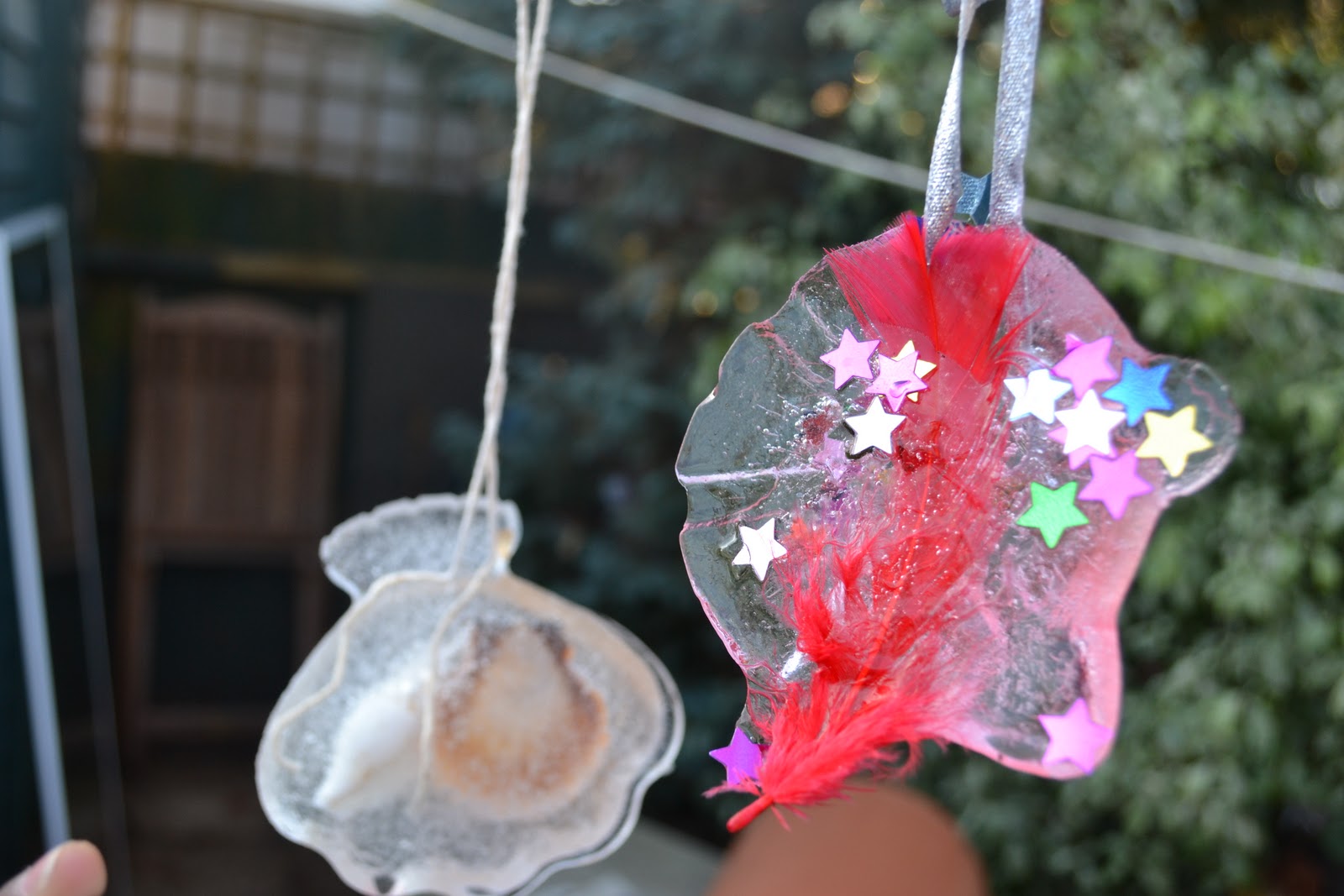
The cold weather has provided us with a great opportunity to make some lovely ice sculptures this week. We were reminded about them when one formed naturally from water left a sand mould in my son’s sand and water table. I photographed the result above.


So the next evening the remaining moulds were washed and the craft box delved into. We also took a few flowers from the garden and used some fir cones and acorns. The resulting tray of sculptures were then placed outside. Alas that night it didn’t freeze, but this morning we the jackpot with five beautiful sculptures. It is very cold today so hoping that some of them will survive.


shell in ice scultpture

ice sculptures


We did learn a few things along the way, which I hope will help you if you try them.

• We placed string and ribbon in two of them which meant they could be tied onto a line. This really helps them to catch the light and they can easily be seen from the house. So I would recommend you do that with all your sculptures. The ribbon sculpture stayed on the line longer than the string one.

• Make your moulds close to an outside door as they are not the easiest to transport. We had placed ours outside we had to top them up with water.

• Place them close to the house because your children are likely to want to keep popping out to check on them. They are more likely to freeze if just placed a little away from walls and other frost protection.

• Do not fill them with too many objects, as the transparency is one of the best things about them.

You don’t have to use moulds. Tonight we are going to experiment with plastic cups, saucers, food dye, and also try and make our own icicles.


Monday, 23 January 2012

Watching Birds in the Garden: A Great Kids Activity

Just now there is quite a lot in the media about garden birds. Next weekend 28/29 January 2012 is the RSPBs Great Garden Bird Watch and people have been noting that they are not seeing so many birds in the garden during this, so far, mild winter.  This article reckons there are staying in the countryside.


In our garden this week we have seen our resident wren, starlings, blackbirds, blue tits, great tits, 2 robins, pigeons, a greater spotted woodpecker and the blackbird shown above eating berries from the ivy.

Spotting and identifying birds is an ideal activity for children this time of year. You can see them through the window and you don’t necessarily have to use binoculars. Binoculars are not always easy for small children, who may have difficulty finding and focusing on the subject. A bird table or feeder will encourage the birds as may a bird water bath. The birds in our garden are attracted by the oak tree next door and our shrubs with berries.

It is useful to have a bird book or identification sheet close at hand to help with deciding what has been seen. Spotting birds from upstairs windows and also from the front of the house adds a bit of variety. We only ever see sparrows in our front garden. Possibly because there are more hedge type plants in front gardens. You could also pop outside to check which birds you can hear. Our garden is rarely without birdsong or noise.

Spotting birds is a great skill for your children to have. It makes walks and journeys far more interesting and helps them appreciate and learn about wildlife. I can’t now resist in showing you below what I spotted last week. No, it wasn’t in my garden, but just off the river Thames in London. If you are lucky enough to be close to a kingfisher, it must be one of the easiest birds in the country to spot.

Kingfisher on the Thames


The whole family is looking forward to the garden bird watch next weekend. We will try and complete our hour before midday as usually there are more birds about. Hope you find the time to do the same.


Friday, 6 January 2012

Six Resolutions for my Garden in 2012

What are Yours?
Spending time in my garden, gardening with my son, and thinking and reading about all things horticultural, provide me with inspiration, stimulation and a sense of purpose. I’d be lost without a garden. So the New Year brings new thoughts on how I get to grips with my garden. This time last year I looked back at my garden. This year I am looking forward.

I resolve to:-

1 Do what all keen gardeners want to do – get out into the garden more often. Building work in my house means that I can now see my back garden from my kitchen and also better from the living space at the back of the house. So I am hoping that this new visibility will entice me out more often. The housework will suffer, but what the heck. I will also join the ranks of the early risers for the odd spot of gardening before breakfast and before the rest of the household has risen.

2 Plant those plants. All too often plants get bought and seedlings get germinated and then stay in their containers far too long, drying out, getting root bound and dying. I say no longer in this garden as I go out to pick up the azalea (still in its original pot) which has been blown over by the wind.

3 Keep a wildlife garden diary with my son. I garden organically and hope that our plot is wildlife friendly. At times we spot our garden toad and we all love seeing the different garden birds. A record will help start to identify who lives with us and visits us. It may also encourage my son to write some entries in the diary and me to think about planting more to encourage wildlife into our garden.

4 To get daddy out into the garden. My brother in law is just about to start a vegetable plot with my niece and nephew. This got me thinking that whilst I love performing my earth mother role with my son perhaps it would be good for my son not just to identify gardening with me.  A bit more daddy in the garden would be a good thing.

5 Use that greenhouse. Last year I was lucky to have acquired the use of an all singing all dancing greenhouse, with light, heat and electricity. I am ashamed to say I hardly used it as I found it rather intimidating. This year I will go for it big time and hopefully grow more exotic and tender fruit and veg.  It is not just going to me who will to be bold in growing, my son already has a packet of white sunflower seeds to experiment with.

White Sunflower Seeds

6 National Gardening Week. The RHS are running a National Gardening Week commencing Monday 16 April 2012, including a new campaign for School Gardening.  Such a good idea, can’t think why it hasn’t happened before. I am actively going to publicise this locally and perhaps organise some local events. So watch this space.

Please let us know what your plans are for going Out2play in your garden this year.

Friday, 16 December 2011

A Christmas Star from the Garden


Star Made from DOGWOOD


Christmas Star
Christmas Star

Last spring when I cut back my dogwood in the front garden I had good intentions.  I knew that the lovely red stems which had brightened up the garden all winter long could be put to further use.  I hadn't expected it to take me quite so long to use them.  Last weekend we brought the holly and other foliage in from the garden and settled down to decorate the house. This year the holly has produces loads of berries and the blackbirds have been feeding off them.  I have therefore decided no twigs with berries in the house this year.  They are to be left in the garden for the birds to feast from.   So the dogwood star we have made provides us with some festive red.


Bunch of Dogwood Stems
A bunch of Dogwood Stems


dogwood
Dogwood

We started with the bunch of stems and then cut nine lengths of the same size.  We then tied triple stems to from a triangle.  It would have been lovely to use the red raffia.  However for my six year, and also myself, it was far too difficult connecting all the pieces of twigs whist trying to tie.  Our solution was to use red rubber bands.  After making another triangle all we needed to do was to attach the two together and our star was born.

We hope you like it. Other flexible stems could also be used, especially those from willows. Merry Christmas.  Hope you manage to bring some of your garden into the house this holiday.  And I don't mean mud!


Friday, 28 October 2011

Autumn Colours at Stourhead


We hadn’t planned to visit, but after a whole day of rain we needed to get out for an autumn ramble. Helpfully the evening before Radio 4’s PM programme had interviewed the head gardener from Stourhead.  The passion he displayed for the garden was infectious and helped us to decide that a visit to see the Autumn colours was a must. We were not disappointed.

Situated in Wiltshire just off of the A303 it is one of the best landscape gardens in the world. With tremendous views, situated at the source of the river Stour, which then runs south all the way through Dorset until it reaches the sea near Bournemouth.


Its a great garden for kids, as well as everyone else. There was a tree trail highlighting champion trees and a simple spotter’s guide on offer. However there was no play area. None was needed.


The garden was very busy – lots of people must have been listening to Radio 4. There were lots of families with children and all seemed fully occupied with the endless opportunities for collecting leaves – we played a game matching the red of my son’s jacket, running around, clambering over tree trunks and stumps, jumping in puddles and mud courtesy of the previous day’s rain and playing under branches full of beautifully coloured leaves.


The vistas were spectacular, the light superb and the refection of water from the beautiful lakes mesmerising. No human being could be unaffected by the rich tapestry created by the trees. It is a garden that has a restorative effect on adult and youngsters alike. 

Now enough of me waxing lyrically.  I just hope that everyone sometime somewhere gets to experience such beauty.

Sunday, 23 October 2011

Apple Day and the Abundance Project

Picking apples from a tree must be one of the most valued childhood memories. Its great to have apple trees in your garden, but the harvesting, storing and preparation of them can be a mixed blessing. Having given away loads of our apples to family and friends and stored away several box full we were still left with rather a surplus. Kingston’s apple day solved our problem for us.


We took our apples and some empty bottles to Kingston Environment Centre. Here we washed them, cut them up into large pieces and put them, core and pip and skin as well, into an apple grinder. Next the pulp was placed into an apple press. A couple of turns of the screw and hey presto we had our own apple juice. Ours was particularly pretty as the addition of some apples with pink flesh added a perfect blush to juice.


Apple day events are held all over the country usually as close to Apple Day on the 21 October. A friend of mine who lives in a village in Somerset takes all her apple to the village apple press. It would be great if urban communities could have something similar.


Yesterday we learnt how easy it was to make pressed apple juice with just a bit of arm power. I also found out about Kingston’s Abundance Project. There is no more a sorry sight that seeing fruit rotting on the ground because nobody has harvested it. The project aims to rectify this by harvesting the seasonal glut of local fruit, such as apples, pears and plums and redistribute the surplus to the Kingston community on a non-profit basis. A great idea and we will certainly be helping to pick next year.

There is also a national fruitshare scheme where you can register as a fruit seeker of a fruit sharer. Rather like the landshare scheme.  With projects like these lets hope in years to come we will all be eating local apples and fruit going to waste will be a thing of the past.
Related Posts with Thumbnails