Showing posts with label Childrens Gardening. Show all posts

Friday, 16 November 2012

Floral Friday: Cosmos - Family Friendly Plants


cosmos family friendly plant


The Cosmos is the sort of flower that you may have seen in other people’s gardens and thought I would love to have that displaying in my garden.  It’s a lovely statuesque cottage garden flower, usually with very pretty pastel colours and feathery leaves. It is rather magical for toddlers as it grows to just about their height making it ideal for viewing, smelling and picking.  In fact the more picking the better as that will encourage more flowers to bloom.

The packets of seeds sold in the shops are usually those of Cosmos bipinnatus, which is an annual, and the variety you will most commonly see in the summer. 

cosmos
 
The characteristics that make it family friendly and a good seed to sow with you children are:-
  • It is pretty easy to grow from seed.
  • It usually only takes about 12 weeks from sowing to flower – so you will not have to wait too long.
  • It has a long flowering period, as it will flower from June to September or even the first frosts.  Certainly I have seen them flowering into late October this year.
  • You can sow in pots or direct into the ground.  Although not a wildflower they were used to magnificent effect  in the Olympic Park planting scheme this year.
  • Good cutting flower.
  • Butterflies love Cosmos.
 
 
cosmos under apple tree
 
 
There is also one other type of Cosmos worth a mention because children love its scent.  It is the Cosmos atrosanguineus   If I say a good variety to buy is 'Chocamocha'  then I am sure you will have guessed the aroma.  Yes there really is a plant with a chocolatety smell. 
This is a perennial plant which means it will comeback every year.  However it is not fully frost hardy.  To minimise frost damage you need either to protect its roots with a cloche or to take the plant into a frost free environment, such as a greenhouse for the winter.
Add  a packet of  cosmos seeds to your spring shopping list or even better pop a couple of packets in your children's Christmas stocking this year.


Friday, 26 October 2012

Floral Friday - Michaelmas Daisy - Family Friendly Plants


Bee on Aster

A good late summer performer for the garden is the Aster or Michaelmas Daisy. So called because it has daisy-like flowers from pink, purple to blue and it flowers at the time of Michaelmas, on 29 September when in parts of Europe remember Archangel Michael.


Its reliability and hardiness help to make it a truly family friendly plant. Other characteristics include


  • It is can be bought as a perennial, which means it comes back every year.

  • The bees like it and it provides late summer nectar for them.

  • It is low maintenance.

  • It does not succumb to slug and snail damage.


If growing with children you could grow from seed. However for me this plant’s value lies in providing instant late summer colour. There are many other flowering plants that would be easier for them to grow. I would suggest a visit to the garden centre from the end of July onwards to see what varieties are available.  You will need to cut back the plant at the end of the season.


A number of common varieties are about 4 feet high, but some of the taller varieties can start to look a bit scraggy towards the end of the season. Worth considering are shorter and dwarf varieties like the one below, no more than 2 feet tall and which will not be such a target for a football .


Aster lateriflorus 'Bucks Fizz'


This Floral Friday post is one of a series suggesting family friendly plants you and your children could grow in your garden.  Please take a look at our previous suggestions.

Friday, 12 October 2012

Floral Friday - Chives - What to plant with your Kids

Chives

It is its versatility that makes chives such a great plant to grow with your kids.  It is of course a culinary herb and part of the onion family, but its flowers are beautiful – a delicate ball of pinky, purple.   


The child and family friendly properties of the chive plant Allium Schoenoprasum include :-


  • It is a hardy perennial, which means it will come up every year.


  • It has edible leaves and flowers.


  • It requires little maintenance.


  • It is relatively pest free.


  • Its clumps will cope with being hit by balls.


Chives are an essential addition to any herb garden. Equally you could equally grow them in any flower border or in pots. Ideally they like well-drained soil and full sun, but they will grow in other conditions. You can grow from seed in the spring or buy one or two pots from the local garden centre. You will need to cut it down in late summer or autumn so it can grow again in the spring.


This year in our house we have watched and photographed the flower heads developing, picked them as a cut flower and eaten both leaves and flowers. We still have some dried chive flowers in a vase. All from one plant. Not bad I reckon!

If you liked this then please take a look at other family friendly plants selected for our Floral Friday feature,

Friday, 5 October 2012

Floral Friday - Nasturtiums - What to Plant with your Kids

If you are not too sure what flowers to plant with your kids this is a good one to get going with.  It is an easy- grow annual. 

Nasturtiums

This plant’s family friendly features include:-
  • Large seeds which are easy to sow.
  • 8 Weeks from seed to flower. Short waiting time - Very child friendly!
  • It will self-seed.
  • You can sow direct into the ground or sow in pots.
  • Both the flower and leaf are edible. 
  • It requires very little maintenance.

I have a childhood memory of a story where a roof was thought to be on fire. When the fire brigade arrived it was found to be a roof of trailing nasturtiums. You can certainly get some fiery colours, orange, blood orange, red and yellow. Though I have yet to find a roof that matched the image placed in my mind by that story.

Nasturtiums at Chelsea Flower Show

Trailing varieties are available and they are also lots of more compact ones on the market suitable for pots and edges of the border.


Sometimes butterflies lay their eggs under nasturtium leaves. When the eggs hatch hundreds of tiny caterpillars can munch their way through them. A great chance to read  together the Hungry Caterpillar by Eric Carle.   You may need to check the leaves regularly and remove the caterpillars. Black fly also like nasturtiums. Your child can help get rid of these by watering them and the plants all over with a weak solution of eco washing up liquid.

Both leaves and petals are edible. Some children may find that their peppery taste does not suit them. Although they are annuals it is easy to ensure more will come up next year.   If you let their seeds fall to the ground some will probably self -seed the next year. The seeds are also very easy to collect and save to plant next year. So one packet of seeds will last a long time - my sort of plant!

Friday, 28 September 2012

Floral Friday: Edible Flowers - Calendula


Calendula officinalis

Calendula officinalis is one of my top ten flower plants to grow with children.  Everyone thinks of a sunflower as a children’s flower.  The pot or English Marigold may not grow so tall, but it matches the sunflower’s beauty, petal pattern and gorgeous orange and yellow colours.


Marigold - child friendly plant


Its family-friendly characteristics include:-


  • It is an annual & easy to grow from seed.


  • It will self- seed.


  • It is bee friendly.


  • The plant will keep flowering from June/July to the first frosts (though you will need to keep deadheading for this to occur).


  • It has edible flowers – use in salads or to dye rice.


You do not see the grown flowers very often in garden centres so you will need to grow from seed. There is a wide variety of orange to yellow flowers available at varying heights.


You can germinate in pots or sow direct into the ground once the soil begins to warms up in March /April.

Do not confuse with French Marigolds Tagetes Patula which are not edible.


Marigolds on edge of vegetable bed


It is also used as a companion plant particularly for certain vegetables. It is therefore often a favourite on the allotment.  It repels whitefly from tomatoes and can lure aphids away from beans. It also attracts beneficial insects, including ladybirds, lacewings and hoverflies, all which prey on aphids.  Wish my vegetable plot looked like the one above.

Tuesday, 7 June 2011

The Language of Gardening that will get Children Growing

Crops in pots


Growing your own and getting the whole family involved in gardening has become cool over the last decade.

We no longer have vegetable plots, but edible gardens. Our flower gardens have gone vertical and our roofs have gone green. Kids at school no longer garden, but grow. Though we still have loads of school gardening clubs. Everyone wants a sought after allotment, but community gardens and land shares are now real alternatives. If you haven’t got a garden you can still take the one pot pledge.

The focus on growing food is highlighted by some lovely slogans. So we now have:-

  • Ledge Veg
  • Crops in Pots
  • Plot to Plate
  • Fork to Fork
  • Welly to Belly
There’s bound to be more, so please add to the list by leaving a comment.

Vertical garden in an urban landscape

Our children attend Seedy Sunday and Sow and Grow events. For those who like a combative approach there is Guerrilla Gardening and Seed Bombs.

On a slightly more serious note we also have food security. A reason for growing your own food you will see more often raised on US gardening websites that those in the UK.  E Coli outbreaks, knowing where are food comes and dealing with food shortages may all well be issues are children have to deal with in the future.

However, for now, whether you garden or grow, they are all life skills for our kids. I love this new language of gardening.  Its great for our children to grow up with this new vocabulary.


Friday, 27 May 2011

Children's Gardens at RHS Chelsea

A Child's Garden in Wales

The Chelsea Flower Show must be one of the few UK flower shows that does not encourage children to attend.  I only saw one child visitor and two children behind a stand on the day I attended. Children's growing was highlighted in several gardens this year.

My favourite was A Child's Garden in Wales. A 1940s inspired garden created by Anthea Guthrie, with the teenage boys from special needs schools in Heronsbridge and Ysgol Bryn Castell Wales with whom she had been working with for two years.  Home made footballs and hobby horses, a rusted iron junk fence with umbrella spokes all feature.  No plastic toys in sight.  As the garden is set in 1947 most of it is given over to fruit and vegetables.  The few annuals children then would have grown are surprisingly similar to those children would have grown today, including Love in the Mist, Calendula, forget me nots and night scented stock. They are similar to the easy grow flowers seeds I use with my son.  Its great that the children researched the history of the garden

Calendula flowers amongst the vegetables

Another group of schools showcasing flower and food growing were to be found at the Miracle Growers Learning Journey garden.  If you look at their site  you'll see they had some royal visitors.

Radishes from the Learning Journey

The cut flower part of the garden highlighted 9 inner city schools in south east London where the children grew their own cut flowers and able to take a learning journey into plant care. The project recognised that many urban schools are surrounded by hard urban views with little foliage and flowers. It demonstrated that
even schools without land garden soil can grow in containers,


Similarly the fruit and veg part of the garden demonstrated how the children in schools throughout the country grew food without a vegetable patch using window sills and containers on hard landscaped areas. The photograph shows the large variety of radishes which were grown, a really easy plant for children to grow.

If you have a favourite Chelsea garden this year please let us know.  If you are growing food and flowers in your school please get in touch we'd love to hear from you.

Thursday, 26 May 2011

Three Doors at RHS Chelsea that all Kids will Love

I visited the Chelsea Flower Show in London yesterday.  If you are in the UK you will know that the papers and television have been overflowing with reviews of it.  The show certainly lived up to expectations.  I arrived as the gates opened at 8.00am which allowed for a quiet first hour and enabled me to take photos without the crowds.

There is a fuller more meaty post to follow about what the show had to offer children's gardening.  What I often take away from garden shows are one or two details where I think, I could do that or that will work in my garden.  On that basis I'd like to share three images with you.  They will appeal to children of all ages.  The first is from the Fever-Tree's Tree House garden designed by Stephen Hall.  This had a beautiful low level tree house with the most enchanting door.  No child would be able to resist going through this.  It conjures up images of secret gardens and hidden worlds.  Just raising the house off the floor by one/two feet added to the interest.


Tree House Garden

Faces in the garden are a firm favourite of mine.  Carving a face in the door to this tree house such a simple and clever idea.  It could translate quite easily to a tall garden gate or even a fence.


Finally a 'dor' with a difference.  A sculpture of this minute dormouse rolled up asleep in a  nutshell was quite
exquisite.


Wednesday, 27 April 2011

CBeebies, Gardening and Mr Bloom's Nursery

At the beginning of last year I wrote a piece on the blog about CBeebies and Gardening.  The BBC has now applied even more creativity to its childrens' programming and produced an entertaining veggie puppet show with Mr Bloom's Nursery.  Its worth a watch even if you don't have kids - well a short watch.  Its website has a great range of games and gardening related actitivies for younger children.

At the core of the daily life of the nursery are a group of singing, talking and moving veggies with rather traditional names.  There is Margaret the Cabbage and Joan the Fennel.  Soft toy vegetables are rather more endearing then the usual plastic vegetables available as part of food sets.  If you like the toys on Mr Bloom's Nursery then you are bound to fall in love with those featured our kidsinthegardenshop.  Each character has floppy arms and legs and a very smiley face. 


Kids in the Garden Soft Toy Vegetables


Tom Turnip

Tammy Tomato

Will they encourage and inspire your children to get growing and to eat vegetables?  They certainly will entertain them and provide loads of fun and from the planting of little seedlings great things can grow.

Wednesday, 12 January 2011

Happy First Birthday. Garden Stars of the Year

We have had a great first year on the blog. When I asked my son what he had enjoyed most about our garden, without any hesitation he listed the following:-
  • Digging.
  • Looking at the vegetables and feeling how heavy they were.
  • Eating the vegetables.
  • Finding ‘bones’ in the soil.
Gardens are great spaces to reflect in and also reflect about and its good to see that his memories can be so easily recalled. Our little plot this year has been tranquil, productive and beautiful. The veg area was a great success (why oh why didn’t I start it before?).


My garden stars of the year have been:-
  1. Very unexpectedly the french beans which were so very tasty to eat and easy to grow. So there will be more grown up the fence this year and over my son’s den.
  2. Nasturtiums which are such good flowers for children to grow. Dare I say even better to grow than sunflowers. Ours reseeded from last year. Because of last years cold winter they took a while to get going, but then flowered until November. It was lovely having some extra peppery flavour to our salads.
  3. There are no hostas grown in the ground in the garden as they are munched to death. But hostas in pots do survive and my Sum and Substance hosta looked wonderful this year.
  4. My son who has really enjoyed all garden activity.  When it was suggested he should draw a flower he didn't just draw the standard sunflower-type flower.  He produced a whole page of Venus Flytraps, including their food.  I think perhaps we have visited Kew Gardens a bit too often.
Looking forward to our 2011 garden.

Thursday, 30 September 2010

Gardening Helps to Grow your Children.


Get gardening with your children and give them skills they will use for the rest of their lives. All of us committed to children’s gardening know that it helps to promote a healthy and active life style. New research by the Royal Horticultural Society shows that it can also improve confidence, resilience and self-esteem. The report concentrated on Gardening in Schools.  However much of its findings can also translate into gardening at home with your kids.


Here are a few detailed findings of the report pertinent to gardening in most settings.

  1. Tasks such as planting seedlings and tying plants to canes can help to develop children’s fine motor skills.
  2. The changeable nature of gardening projects and uncertainty e.g. weather and plant disease forced children to become more flexible and think on their feet.
  3. Waiting for crops to grow taught the value of patience.
  4. Public praise for a school garden generated a sense of pride.
  5. A calm outdoor space helped to improve children’s concentration.
  6. Gardening helped children to take responsibility for their own physical health and diet. Children who grew their own crops displayed a greater willingness to eat new vegetables.
What better reasons are there for you and your children to get gardening.  Don’t leave it all to the school.


Wednesday, 7 July 2010

HAMPTON COURT FLOWER SHOW 2010: GARDENS FOR CHILDREN


When I visit gardens I am always on the look out for ideas that will get children playing and really looking at their environment. This year there was lots on offer at the Hampton Court Flower Show.  A garden which aims to raise awareness of overactive bladders may not be an obvious candidate for having child appeal. Yet any garden with a giant pink tap hovering in the air and pouring out water is a great eye catcher. There is no doubt that children will be intrigued as to how it works and how magical it really is. I am sure there will be quite a few ‘I want one of those’ heard during the course of the show. And, indeed, a smaller toned down version would be great fun.


A Matter of Urgency

A garden with a more traditional child-friendly feel is the Playful Garden designed by Southend Borough Council. It combines a blend of play, vegetable and landscape garden, all with a quirky feel, so that plants hang down rather than grow up. The tunnels in perspex are designed so that children can see the roots and animals living in the soil. The design and planting encourages lots of different type of active play and interaction with the plants and structures. I liked the arena – giving children the freedom to run around, tumble down or to dress up and put on a play.


Playful Garden


Root World Tunnel

There has been lots of publicity the Legoland Garden, which has great novelty value for the kids and is definitely better than plasticine flower garden shown at Chelsea last year. It is unlikely that you will be able to use similar features in your own garden. If you miss it at Hampton Court you will be able to see it when it is rebuilt at Legoland Windsor.


The Legoland Pirates Landing Garden

For me one of the highlights of this years show has to be the Home Grown Area. You can take tour around the fields of an arable farm in miniature and a similarly miniature market garden or is it a large allotment.  There is an orchard and chickens and an unusual mushroom growing area..  Everything looks great and children can really see where there food comes from and how ornamental it can all be. Inspirational.

Finally there is the recycled containers competition from Girlguiding UK.  I rather like this container just about identifiable as a shopping trolley.


Thursday, 29 April 2010

Gardening Websites

I have been updating my website to include a whole new section on Children's Gardening.


I was particularly struck by a comment from a mum saying that she would not know the difference between sweet peas and nasturtiums. It is easy to forget that the popularity of getting children to garden has only been around for a couple of years. Many parents may not have been exposed to such expereince when they were little. So I have tried to include the sort of information someone would want to know if they had not gardened or grown anything before and were now doing so for the first time with their 4 year old.


Whilst looking to see what resources there are already on the web I have found two sites which I think are great for first timers and also contain a few tips for more seasoned gardeners. The first is the BBC Digin site. This has information to help you to plan your growing space and some neat videos on what to do and how to plant. Their newsletter comes out regularly to remind you what you could be planting. Ideal if you are like me and start sowing and planting and then thinkg you have loads of time only to find the days have turned into weeks.


The other site is Eat Seasonably. The site has information on what to grow now, how to grow it and what to eat now all with a slide show explaining things. It has a great interactive guide on what is in season when.

Wednesday, 31 March 2010

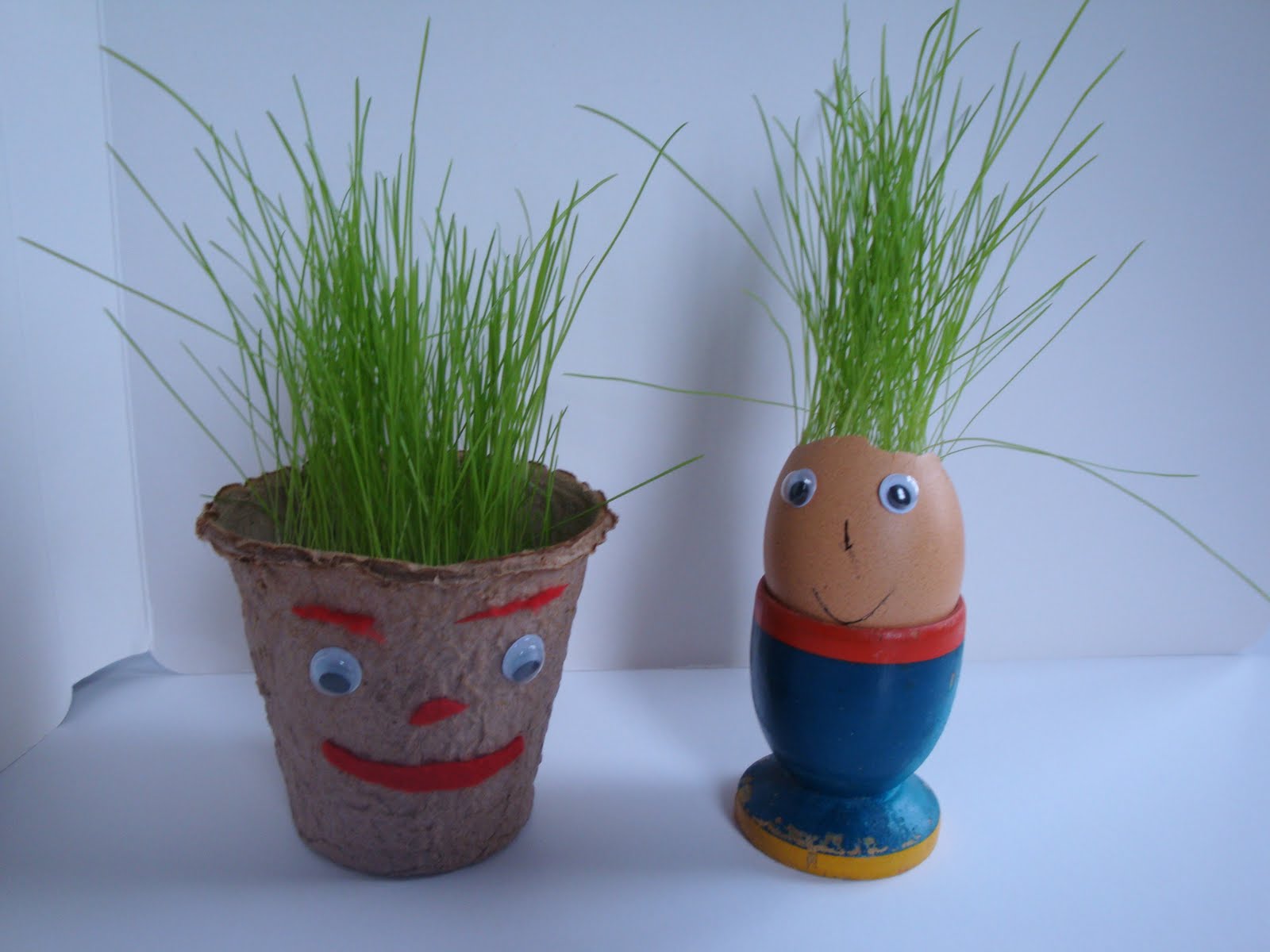
Easter Egg Grass Heads


We have been growing indoors for the last couple of weeks and have produced the grass heads shown above. They have been great fun and are an easy introduction to children’s gardening.

The recipe is as follows:-

1 pot – ours was a paper pot from Sainsbury’s gardening section.
1 empty egg shell – cracked carefully and as close to the top as possible.
Grass seed.
Potting compost.
Water.
Craft eyes from the local art shop.
Red sticky back felt.

The pot and eggshell were decorated first and then filled with compost. The grass seeds were added on top of the soil and the soil kept wet. They then lived on the kitchen window sill and were lovingly watered and handled everyday. Not too much though as otherwise the pot went soggy and the eggshell easily overflowed. The grass seeds took about 10 days to germinate and about another 2 weeks before they needed a trim.

You can, of course use cress or chives which have the advantage of being edible. We are going to keep these going for as long as possible. There was great delight today when they had a haircut. It made we wonder whether I had a budding gardener or hairdresser on my hands, but I suppose it is all about life skills.

Our shop has some great gifts that will help inspire you and your children to get growing in the garden. 

Friday, 26 March 2010

Eco Friendly Pots


Recently I have seen snippets of information on the web about coir pots. Last week I spotted some for sale at my local garden centre. RHS Wisley is also selling herbs grown in them. So I thought I’d give them a try.


I think they are great and what’s more so does my five year old who played for a good hour with the pots you see in the photo and of course the box they came in. It got me thinking that as well as using them to replace plastic pots there are all sorts of other uses. From containers within the house, garden shed and greenhouse to covering those plastic pots and flower boxes if you already have them and don’t want to replant. They are just so much more pleasing to the eye than plastic.

They are 100% natural and it shows. At present the outside is quite smooth but they do moult a little. The ones I saw at Wisley were very hairy, but of course you just plant them in the ground and they naturally decompose. That means they have great potential for children’s gardening as you can grow one of 2 seeds per pot and then plant in the garden without your kids having the fiddle of transplanting the seedlings. Out of the ground the small pots last for about 12 months and the trough for 2/3 years.

The pots come from Sri Lanka which is a country very close to my heart. We were out there at Christmas and saw the coconut husks being collected. Any purchase of goods from there may just help the economy to pick itself up now that peace has arrived. There is loads of information here and whilst more expensive than the plastic version they will not break the bank. I’d be really interested to know what other people think about them.

Lynda
http://www.kidsinthegarden.co.uk

Thursday, 4 March 2010

Children's Gardening: Ready, Steady, Grow


It is World Book Day today so I thought I would review my most recent gardening book - The Royal Horticultural Society's Ready, Steady, Grow - Quick and Easy Gardening Projects. There were no reviews on Amazon when I ordered it so I was not quite sure what to expect. It is 80 pages in typical Dorling Kindersley style - easy to read, plenty of photos and clear layout. It doesn't state an age range. I would suggest for children using the book on their own from about age 7.

I was slightly disappointed when I first glanced through it, but it has appropriately, grown on me. It covers a number of plant-related projects and the growing of flowers, veggies, herbs and fruit. I liked the way it clearly states how long each of the activities will take to come to fruition, so avoiding raised expectations.

There are some great ideas in the book. Sunflower people grown in tin cans with a painted body on and a face etched out in the sunflower would put a smile on any child's face. There are two projects on sprouting seeds, an area often overlooked by children's gardening books. Yet these seeds are simple, easy and fast to grow; a great beginners activity or one for the little ones. I also loved the idea of growing watercress, especially from cuttings taken from a bag of supermarket watercress. Most gardeners grow from cuttings and it is a great skill for children to learn. I shall certainly be trying this one out with my son.

I wasn't quite so keen on the enchanted path project detailing how to make cement stepping stones in a leaf shape. It also would have been useful to see the book cover relevant web links and where to source some of the plants and materials mentioned. There are other books on the market covering this topic, but if you don't have one on your bookshelf and what to encourage your budding gardeners then this is the right time of year to buy this book and get growing.
Related Posts with Thumbnails